
The MAPT Skin Protocol: Build Results Step-by-Step
Why Some Skin Treatments Create Change — And Others Simply Maintain
The aesthetics industry is full of trends, products, and treatments promising “glowing skin.” But in reality, some treatments only work at a very superficial level.
Facials, for example, can absolutely improve how the skin looks and feels; they can hydrate, exfoliate, calm the skin, and create a fresher appearance, but only for a very short period of time.
For most people — men especially — monthly facials are often unnecessary unless you genuinely enjoy them as part of self-care or relaxation.
For many, one or two good facials per year is more than enough.
Why?
Because while facials may improve the surface appearance of the skin temporarily, they rarely create significant biological change in skin structure or long-term skin quality, like what microneedling does.
That distinction matters.
Surface Treatments vs Structural Treatments
One of the biggest misconceptions in aesthetics is that all treatments improve the skin in the same way.
They do not.
Some treatments work primarily on the epidermis — the outermost layer of the skin (the superficial part).
Others work deeper within the dermis, where collagen, elastin, vascular support, and structural regeneration actually occur.
This is where real long-term skin change happens.
Why Microneedling Actually Works
Microneedling is one of the most effective regenerative treatments because it stimulates change within the dermis rather than simply polishing the surface.
During treatment, controlled micro-injuries are created in the skin using fine needles.
This triggers the body’s natural wound-healing response:
Increased collagen production
Increased elastin production
Tissue remodelling
Improved circulation and nutrient delivery
Gradual strengthening of skin structure
Unlike superficial treatments, microneedling encourages the skin to rebuild itself from within.
That is why it can improve:
Acne scarring
Fine lines
Skin texture
Enlarged pores
Overall skin quality and resilience
The key point is this:
Microneedling does not just make the skin look healthier temporarily — it encourages the skin to behave healthier biologically.
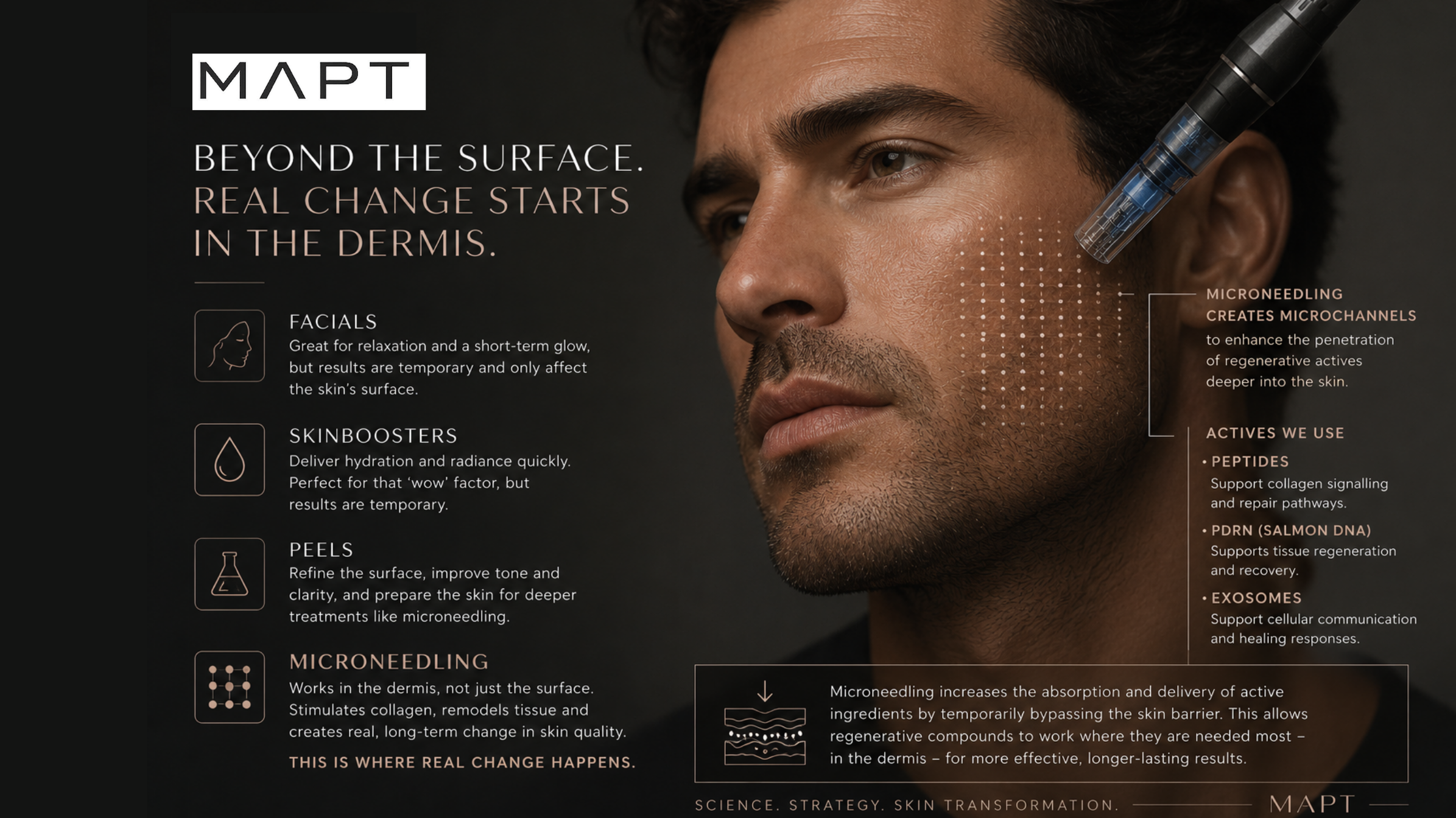
Enhancing Microneedling with Regenerative Actives
At MAPT, microneedling is ALWAYS combined with regenerative ingredients such as peptides, PDRN (polynucleotides) and PDRN (Salmon DNA) to enhance the treatment response even further.
The reason this combination works is that microneedling creates controlled microchannels within the skin. These temporary channels can help improve the penetration and delivery of active ingredients deeper into the epidermal and superficial dermal layers — allowing regenerative compounds to interact more effectively with the skin during its repair phase.
This means the treatment is not only stimulating collagen production mechanically through needling, but also supporting the skin biologically during the regeneration process.
Depending on the skin analysis and treatment goals, this may include:
Peptides to support collagen signalling and repair pathways
PDRN (Ploynucleotides) to support tissue regeneration and recovery
Salmon DNA Exosomes are the best of both as they are designed to support cellular communication and healing responses.
The result is a more comprehensive regenerative approach focused on skin quality, recovery, and long-term structural improvement.
Research has shown that microneedling can enhance transdermal delivery of biologically active compounds by temporarily bypassing the skin barrier and improving absorption pathways.
Why Chemical Peels Still Matter
Chemical peels are often misunderstood.
A good peel is not just about aggressive exfoliation or visible peeling.
When used properly, peels can:
Improve skin turnover
Reduce congestion
Help regulate oil activity
Improve pigmentation irregularities
Prepare the skin for regenerative treatments
In many cases, preparing the skin correctly before microneedling can improve treatment outcomes significantly.
This is where skin analysis becomes important.
Not every skin type should be treated aggressively immediately.
Sometimes the best results come from:
Repairing the barrier
Reducing inflammation
Preparing the skin
Then stimulating regeneration
That sequence matters.
Most People Skip the Basics
One of the biggest problems in modern aesthetics is that people often jump straight into advanced treatments without understanding basic skin function.
Healthy skin relies on:
Barrier integrity
Hydration balance
Controlled inflammation
Consistent SPF use
Proper recovery time
Appropriate treatment sequencing
Without these foundations, even expensive treatments can produce inconsistent results.
The MAPT Philosophy
At MAPT, the focus is not on chasing trends or over-treating the skin. The focus is understanding:
Which treatments create temporary enhancement
Which treatments stimulate genuine regeneration
When the skin should be repaired and stimulated
And how to build long-term skin quality progressively over time
Because ultimately, the best aesthetic results rarely come from doing more.
They come from doing the right things, in the right order, for the right reason.